
Home / Move-out and PCS repairs
Move-Out Drywall Repair in Leavenworth, Kansas
A moving date is fixed and the walls still show every picture, shelf and TV mount you ever hung. It happens in almost every household, and it is a solvable list. Tell us your date and we will build the plan backward from it.
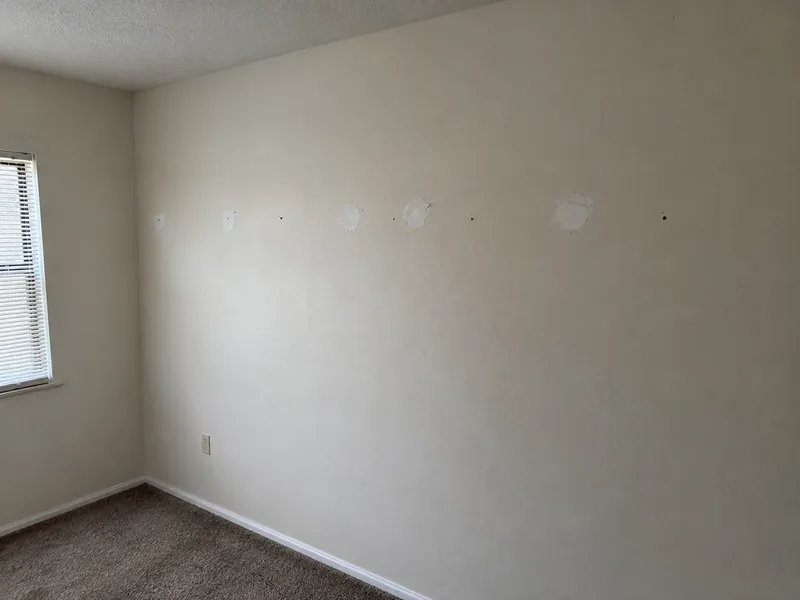
Where the move-out rush comes from
Leavenworth sits right beside Fort Leavenworth, which hosts the Combined Arms Center and the Command and General Staff College. Families who live off-post in town arrive and leave on orders, and those orders rarely line up with a calm calendar. A packing crew shows up on one day, a truck on another, and an inspection lands somewhere in between.
Renters are a big part of the picture too. Roughly 48 percent of occupied homes in Leavenworth are renter-occupied, so a large share of the town is, at any moment, either moving in or getting ready to move out. We take calls from both groups: a family on orders, and a tenant whose lease simply ends.
Our job is narrow and clear. We make the walls look like walls again, so the move can be about the boxes and not the plaster dust.
Signs your walls need attention before you hand back the keys
Walk each room with the lights off and a flashlight held flat against the wall. Raking light shows what a ceiling bulb hides. Look for:
- Clusters of nail holes behind where frames, calendars and mirrors hung
- Larger anchor holes where plastic or metal anchors were pulled out, sometimes with a crater of torn paper around them
- Scuffs and dents at furniture height, and a dent where a door handle meets the wall
- Torn paper from tape, poster putty or hooks that peeled the surface
- Screw holes from a TV mount, a shelf bracket or a curtain rod, often in rows
- Crayon, marker or scrapes that paint alone will not cover
Most of that is routine. A wall with thirty holes sounds like a lot, but each one is a small step, and the work moves faster than people expect.
What we check when we arrive
We start by finding out what the wall is made of and how it was finished. In a house built around the city's typical 1969 era, you may find textured walls where a patch has to blend. In a newer rental, you may find flat paint over smooth board.
Then we sort each mark into one of three groups. Pin-size holes get filled and sanded smooth. Anchor-size holes get a firm backing, tape or a patch, and a few coats of compound. Dents and torn paper get sealed first so the compound does not bubble, then skimmed level.
We also look at the paint. A patched wall that is a different sheen from its neighbors stands out more than the patch itself. We will tell you honestly when a whole wall will need a fresh coat so the repair disappears, and we will tell you when a touch-up will do.
Working to a moving timeline
Compound needs time to dry, and we plan around that rather than rush it. A typical visit for a modest list can be done in one day for small jobs, with a second short visit when several coats have to cure. Bigger lists or textured walls may take a little longer.
When you call, give us three dates if you have them: the day the movers load, the day you hand the home back, and any inspection or walkthrough. We will work out which rooms to do first and what has to be empty. Furniture that stays in the room until the last minute is a problem we plan for, not a reason to panic.
One honest note: we repair the walls. We cannot tell you how a landlord or housing office will assess the result, and we do not promise any outcome on a deposit. What we can promise is that you will know exactly what was done in every room.
What to do before we arrive
- Take down the remaining hangers, hooks and anchors you can pull cleanly
- Leave the screws in a TV mount if you are unsure, and tell us about it
- Move small furniture away from walls and cover what stays
- Keep a list of the rooms in order of importance
- Photograph the walls first, so you have a before-and-after record
- Save a spare of the paint color if you have one, or tell us the color name
- Do not try to fill large holes with toothpaste, soap or wax, which leave marks that paint cannot hide
Texture, paint and the last ten percent
The part people forget is texture. A smooth patch on an orange peel wall shows up like a bandage. When your walls carry texture, we match it with a spray or a stipple tool and let it dry before any paint is applied. If you plan to repaint, tell us before we start so we do not do a step twice.
Quick answers: move-out and pcs repairs
How soon before my move should I call?
As early as you know your dates. A short list can be handled quickly, but a house with many holes and textured walls needs drying time between coats. Calling before the packers arrive makes everything easier.
Do you repair walls I have already started to patch myself?
Yes. Sanded-down filler and half-finished patches are common, and we simply carry on from wherever the wall is.
Can you work while furniture is still in the room?
Often yes, with some pushed to the center and covered. We will tell you before we arrive if a room needs to be clearer than that.
Do you promise the landlord will accept the walls?
No, and nobody honest can. We make the repairs clean and describe what we did, and the final decision stays with whoever inspects.
Ready when you are
Call or text, or request a callback, and tell us your dates.