
Home / Landlord turnovers
Landlord Turnover Drywall Repair in Leavenworth
One lease ends on a Friday and the next begins on the first. That gap is tight, and the walls are usually the slowest thing to fix. If you manage rentals in Leavenworth, here is how we make the gap work.
The shape of a rental market that turns over often
Leavenworth is a renter-heavy town. About 48 percent of occupied homes are renter-occupied, and Fort Leavenworth next door keeps a steady flow of households arriving and departing on military orders, many of them living off-post in town. That means turnovers here are frequent and they tend to bunch up around the same few weeks.
The housing itself is mixed. The median home was built around 1969, a good share predates 1940, and downtown has older buildings carved into apartments. A turnover in a 1969 ranch and a turnover in a Victorian-era upstairs unit are different jobs, and we treat them that way.
How we run a turnover
We walk the unit with you, or with photos if you are out of town, and write a plain room-by-room list. Then we work in a fixed order so nothing gets undone:
- Heavy damage first: doorknob holes, kicked panels, water-stained patches
- Patch, tape and compound in coats, with drying time between them
- Sanding, dust cleanup and a wipe-down
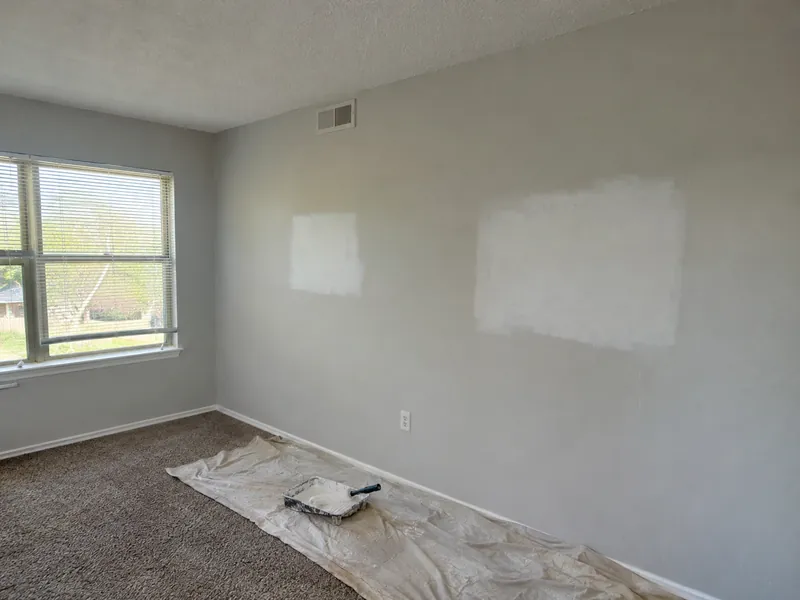
- Spot primer on every repair so paint does not flash or soak in
- A last walk with a flashlight held flat against the wall
Primed and ready is where we stop unless we have agreed on more. Your painter, or you, can come straight in behind us.
What we flag for you
Turnover walls tell a story. Repeated damage in one spot, such as a door slamming into a wall, points to a missing door stop. A stain high on an exterior wall points to a roof or flashing issue. A crack running from the corner of a window may mean movement worth a second opinion. We note those patterns and pass them to you, because repairing the same patch every spring is no kind of plan.
If we find a wet, soft or stained area that looks like an active leak, we will say so and stop to talk before we cover anything. Drywall repair is not worth doing over an unresolved cause.
Scheduling around move-out and move-in
Tell us three dates: the day the tenant is out, the day the next one moves in, and any day your painter or cleaner is booked. We will back-plan from there. For a single unit with modest damage, we can usually fit patch and prime into a short window. Several units at once call for a staged schedule, and we would rather give you a realistic order than a promise we have to retract.
Keys are the practical piece. We can work from a lockbox code or a key drop, and we send a short note when each unit is done.
Before we arrive
- Make sure the tenant has fully moved out, or tell us what belongs to them
- Turn on power and water so we can mix compound and clean tools
- Clear the walls of hooks and anchors the tenant left behind
- Give us a list of rooms in order of priority
- Tell us the paint finish and any texture the unit uses
Quick answers: landlord turnovers
Can you handle several units in one week?
Yes, with a staged plan. Tell us how many and which are most urgent, and we will propose an order that keeps each one moving.
Do you paint after priming?
Our default stops at sanded and primed. If you want full paint on the repaired walls, say so when you call and we will agree on the scope first.
What if a tenant's damage turns out to be a leak?
We stop, show you what we found, and talk about the cause. A leak that is still active has to be solved before any drywall goes back on.
Do you work in older apartments near downtown?
Yes. Older units may have plaster or mixed plaster and board, and we repair them with methods that suit the material.
Ready when you are
Call or text, or request a callback, and tell us your dates.